Here Comes That Rainy Day Feeling Again
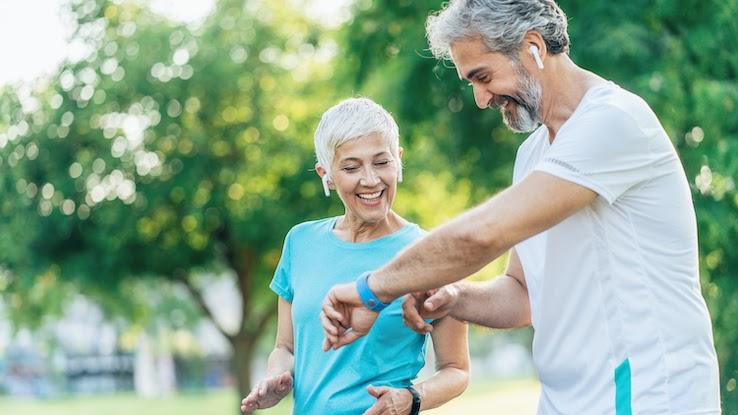
My mom speaks in 10,000-steps-a-twenty-four hour period terms: "I already took my 10,000 today," or "Information technology'southward been a 14,000-steps day." Ever since I gave her a Fitbit in 2015 she'south been a total catechumen. Recently, I snooped on her statistics, and she averaged 13,500 daily steps last month. She'd e'er been a person who liked walking, simply having a specific goal of a minimum of ten,000 daily steps helps her stay more agile. Taking more steps a day has made information technology easier for her to lose a little scrap of weight and manage her loftier blood pressure level.
I took to her on that and now also like to become my ten,000 steps a day when possible. But sticking to healthy habits wasn't necessarily easy for me in 2020. Unlike me, my mom made no excuses and averaged almost 7,000 steps a twenty-four hour period when Spain was in total lockdown between March and early June of 2020. She did information technology by pacing her really-non-that-large Barcelona flat. In those aforementioned weeks, I was sheltering in identify in California and trying to go some activity by using a stationary bicycle. The merely way I could make the activity attainable and not numbingly wearisome was by pedaling and reading at the same time.
The whole feel got me thinking: Are ten,000 steps a day actually necessary? Was my tiresome pedaling equivalent to my previous frequent walks? And where did the whole 10,000 steps a twenty-four hours come up from, anyway?
Even if you lot're not a natural-born walker like my mother, you all the same should be finding other ways to motility that are advisable for your mobility level. The U.S. Section of Health and Human Services (HHS) recommends "that adults do at least 150 to 300 minutes of moderate-intensity aerobic concrete activity a week, or 75 to 150 minutes of vigorous-intensity action, or an equivalent combination of moderate- and vigorous-intensity activity" to prevent cardiovascular disease.
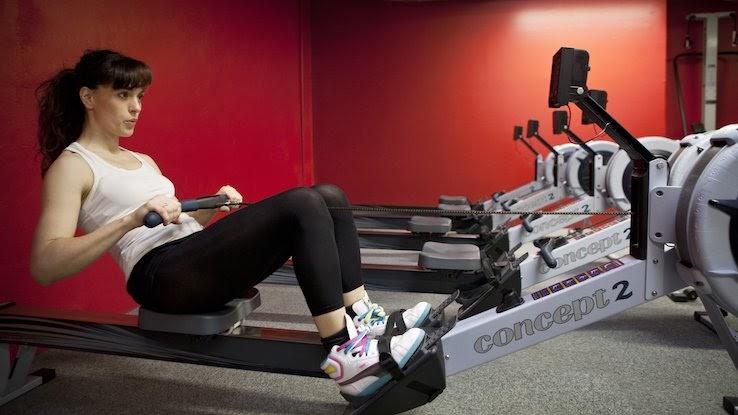
The organization defines an activity every bit "moderate-intensity" if a person can talk but non sing while doing it. During a vigorous-intensity action, "a person cannot say more than a few words without pausing for a breath." That could be a 30-minute brisk daily walk — only also a swim, run, rowing session or some biking.
A 2014 study published in the International Journal of Behavioral Nutrition and Physical Activity found an 11% reduction in take a chance for all-cause mortality — decease from any cause — for a dose of 150 minutes per week of walking and a reduction of 10% for the same number of minutes of cycling. The study — with 280,000 walking participants and 187,000 cycling participants monitored over years — likewise found that walking or cycling had the largest furnishings in that initial exposure category "with decreasing rates of benign effects as the exposure to walking or cycling increased." The written report explains that the sweet spot to get the maximum benefit from walking is in the start 120 minutes per week and the first 100 minutes per week for cycling.
That study isn't alone in disclosing the benefits of walking. A 2020 Journal of the American Medical Clan paper on the association of daily steps and mortality among U.South. adults also ended that "greater numbers of steps per day were associated with lower gamble of all-cause bloodshed." To attain this conclusion, the researchers examined data from groups taking 4,000, 8,000 and 12,000 steps per solar day.
And so Where Did 10,000 Steps Come From?
If you buy a Fitbit, information technology'll outset you off with a 10,000-step goal. "It adds upwards to about v miles each day for most people, which includes nearly xxx minutes of daily exercise," Fitbit states on its website, circling back in one case again to the basic guideline of at least 150 minutes of moderate exercise per week. I'1000 v'four" and information technology takes me more than an hour to walk the x,000 steps.

The Mayo Clinic recommends defining how many steps you generally take on a regular day — with the help of a tracker — then setting short-term goals, "adding ane,000 steps a twenty-four hours for two weeks past incorporating a planned walking programme into your schedule." That mode you can work toward achieving a long-term step goal of 10,000.
The matter is, 10,000 is an easy-to-recollect round number. It's likewise an achievable goal daily. The whole counting of steps has a very compelling quality to it. Writer David Sedaris wrote a whole essay about his Fitbit adoption and long walks that was published in The New Yorker. He refers to his fitness wearable as a "master" and talks about managing to take sixty,000 steps a solar day. Granted, reading most his nine-hour walks makes anyone feel a bit lazy. But the essay also makes some very good arguments in favor of the whole counting of steps.
Fifty-fifty after trading my Fitbit for an Apple Sentry — which has a system of rings and annoyingly buries the number of steps behind several taps — I nonetheless keep thinking in ten,000-steps-a-day terms and making that 1 of my goals. Information technology's just piece of cake to retrieve and like shooting fish in a barrel-ish to achieve.
For certain desk-bound-bound professionals, most of whom have been working from abode for months, something as simple as that can make a departure between a completely sedentary life and ane with the correct amount of exercise. Or some amount of exercise.
Which reminds me: Those 150-300 minutes of moderate-intensity activity or 75-150 minutes of vigorous-intensity activity shouldn't be your only health goal. The HHS also recommends doing muscle-strengthening activities that involve all major muscle groups at least twice a week.
Now let me call my mom. I want to meet how her day is going and ask how many steps she managed to take today. Getting her hooked on planks or button-ups might prove difficult, though.
Resource Links:
https://www.ahajournals.org/doi/10.1161/CIRCOUTCOMES.118.005263
https://ijbnpa.biomedcentral.com/articles/10.1186/s12966-014-0132-10#Sec30
https://jamanetwork.com/journals/jama/fullarticle/2763292
https://blog.fitbit.com/should-you-really-have-10000-steps-a-day/
https://www.mayoclinic.org/healthy-lifestyle/fitness/in-depth/walking/art-20047880
https://www.newyorker.com/magazine/2014/06/30/stepping-out-3
Disclosure: Patricia Puentes' hubby works for Health at Apple. Ask Media Group doesn't turn a profit from the recommendations in this commodity.
Source: https://www.symptomfind.com/health/how-many-daily-steps?utm_content=params%3Ao%3D740013%26ad%3DdirN%26qo%3DserpIndex
0 Response to "Here Comes That Rainy Day Feeling Again"
Post a Comment