Reprocess a Good or Service They Buy Before Selling It Again to the Next Buyer.
4.4 Stages in the B2B Ownership Process and B2B Buying Situations
Learning Objectives
- Outline the stages in the B2B buying process.
- Explicate the scorecard process of evaluating proposals.
- Draw the different types of B2B buying situations and how they affect sellers.
Stages in the B2B Buying Process
Side by side, let'due south look at the stages in the B2B buying process. They are similar to the stages in the consumer's ownership process.
1. A need is recognized. Someone recognizes that the organization has a need that tin exist solved past purchasing a good or service. Users often drive this phase, although others can serve the role of initiator. In the case of the electronic textbook, it could exist, for instance, the professor assigned to teach the online course. Yet, it could be the dean or chairman of the section in which the course is taught.
ii. The need is described and quantified. Next, the buying center, or group of people brought together to help brand the buying decision, work to put some parameters around what needs to be purchased. In other words, they draw what they believe is needed, the features it should have, how much of it is needed, where, and so on. For more technical or complex products the buyer will ascertain the product'south technical specifications. Will an off-the-shelf product do, or must it be customized?
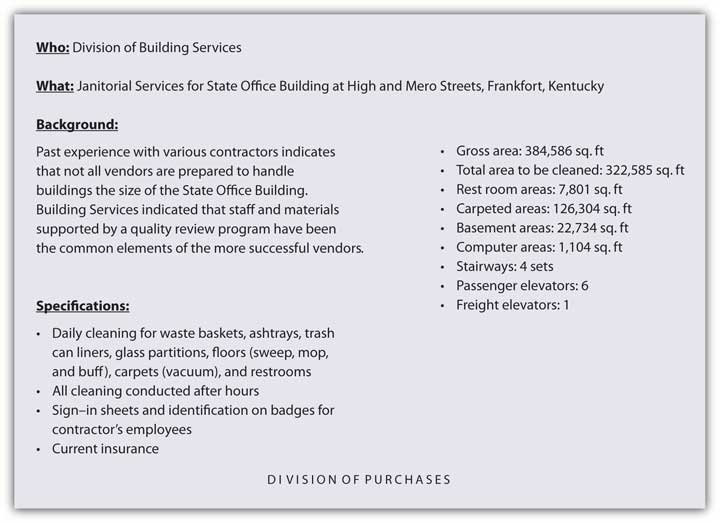
Users and influencers come up into play here. In the case of our electronic volume, the professor who teaches the online course, his didactics assistants, and the college'due south information engineering science staff would try to describe the type of book best suited for the form. Should the book exist posted on the Web equally this book is? Should it be downloadable? Maybe it should exist compatible with Amazon's Kindle. Figure 4.6 "An Example of Product Specifications Adult for a B2B Purchase" shows the specifications developed for a janitorial-services purchase by the state of Kentucky.
Effigy 4.half dozen An Example of Product Specifications Developed for a B2B Purchase
iii. Potential suppliers are searched for. At this stage, the people involved in the buying procedure seek out information about the products they are looking for and the vendors that tin supply them. Most buyers look online first to find vendors and products, so nourish industry trade shows and conventions and telephone or e-mail the suppliers with whom they have relationships. The buyers might also consult trade magazines, the blogs of industry experts, and perhaps attend Webinars conducted past vendors or visit their facilities. Purchasing agents often play a cardinal role when it comes to deciding which vendors are the most qualified. Are they reliable and financially stable? Volition they be effectually in the future? Do they need to be located nigh the organization or can they be in another region of the land or in a foreign country? The vendors that don't make the cut are quickly eliminated from the running.
4. Qualified suppliers are asked to complete responses to requests for proposal (RFPs). Each vendor that makes the cut is sent a request for proposal (RFP), which is an invitation to submit a bid to supply the adept or service. An RFP outlines what the vendor is able to offer in terms of its product—its quality, cost, financing, delivery, after-sales service, whether information technology tin be customized or returned, and even the product'southward disposal, in some cases. Good sales and marketing professionals do more but provide basic information to potential buyers in RFPs. They focus on the buyer's problems and how to adapt their offers to solve those issues.
Oftentimes the vendors formally present their products to the people involved in the ownership decision. If the good is a physical product, the vendors generally provide the purchaser with samples, which are then inspected and sometimes tested. They might too ask satisfied customers to make testimonials or initiate a give-and-take with the buyer to help the heir-apparent get comfortable with the product and offer advice on how best to go nearly using it.
v. The proposals are evaluated and supplier(s) selected. During this stage, the RFPs are reviewed and the vendor or vendors selected. RFPs are best evaluated if the members concord on the criteria being evaluated and the importance of each. Different organizations will counterbalance different parts of a proposal differently, depending on their goals and the products they purchase. The price might exist very of import to some sellers, such equally discount and dollar stores. Other organizations might be more focused on top-of-the-line goods and the service a seller provides. Retrieve that the maker of Snapper mowers and snowblowers was more focused on purchasing quality materials to produce superlative-of-the-line equipment that could be sold at a premium. Still other factors include the availability of products and the reliability with which vendors can supply them. Reliability of supply is extremely important because delays in the supply chain can close down a company's production of goods and services and price the firm its customers and reputation.
For high-priced, complex products, after-sales service is likely to be important. A fast-food eating place might not intendance too much most the afterwards-sales service for the paper napkins it buys—just that they are inexpensive and readily available. Nevertheless, if the eating house purchases a new drive-thru ordering system, it wants to exist assured that the seller will be on mitt to repair the system if it breaks downward and possibly train its personnel to employ the arrangement.
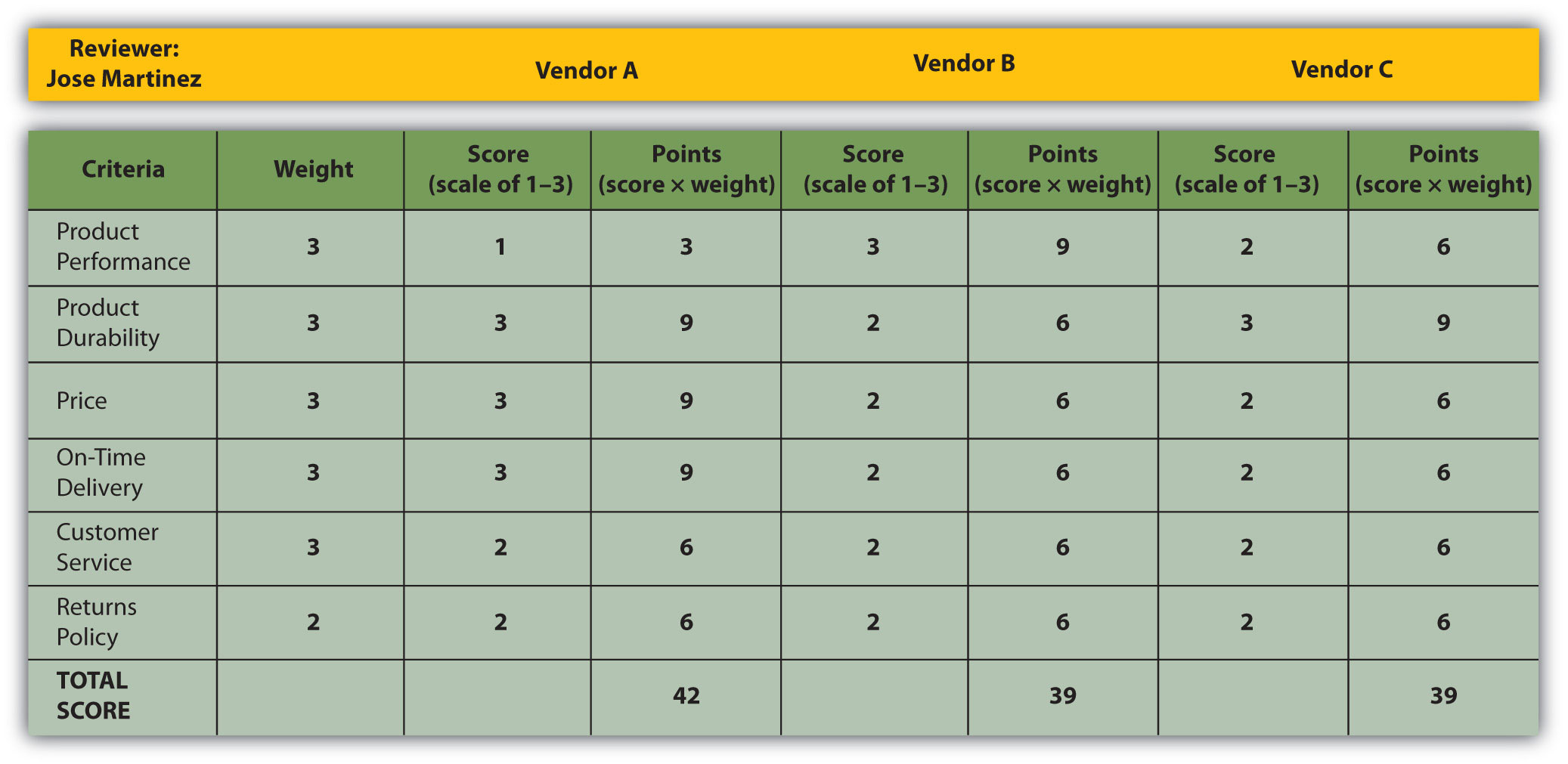
A scorecard arroyo can help a company rate the RFPs. Figure 4.7 "A Scorecard Used to Evaluate RFPs" is a simple example of a scorecard completed by one fellow member of a buying team. The scorecards completed by all the members of the ownership team can then exist tabulated to assistance determine the vendor with the highest rating.
Figure 4.7 A Scorecard Used to Evaluate RFPs
Selecting Single versus Multiple Suppliers. Sometimes organizations select a unmarried supplier to provide the good or service. This tin help streamline a visitor'southward paperwork and other buying processes. With a single supplier, instead of negotiating two contracts and submitting ii purchase orders to purchase a item offering, the company only has to do 1 of each. Plus, the more the visitor buys from one vendor, the bigger the book discount information technology gets. Unmarried sourcing tin can be risky, though, because it leaves a house at the mercy of a sole supplier. What if the supplier doesn't deliver the goods, goes out of business, or jacks upwards its prices? Many firms prefer to do business with more than one supplier to avoid bug such as these. Doing business with multiple suppliers keeps them on their toes. If they know their customers can hands switch their business organization over to some other supplier, they are likely to compete harder to keep the business.
6. An order routine is established. This is the phase in which the actual social club is put together. The order includes the agreed-upon toll, quantities, expected time of delivery, return policies, warranties, and any other terms of negotiation (Brauner, 2008). The club can be made on paper, online, or sent electronically from the buyer's figurer system to the seller's. It can too be a one-fourth dimension order or consist of multiple orders that are made periodically as a company needs a practiced or service. Some buyers club products continuously past having their vendors electronically monitor their inventory for them and ship replacement items equally the heir-apparent needs them. (We'll talk more nigh inventory direction in Chapter nine "Using Supply Chains to Create Value for Customers".)
seven. A postpurchase evaluation is conducted and the feedback provided to the vendor. Just every bit consumers go through an evaluation period afterwards they purchase appurtenances and services, and then practice businesses. The ownership unit of measurement might survey users of the production to encounter how satisfied they were with it. Cessna Aircraft Company, a pocket-sized U.South. plane maker, routinely surveys the users of the products it buys so they can vocalism their opinions on a supplier'due south performance1.
Some buyers establish on-time operation, quality, customer satisfaction, and other measures for their vendors to come across, and provide those vendors with the data regularly, such as trend reports that show if their performance is improving, remaining the aforementioned, or worsening. (The process is similar to a performance evaluation you might receive as an employee.) For instance, Food Panthera leo shares a wide variety of daily retail information and functioning calculations with its suppliers in commutation for their commitment to closely collaborate with the grocery-shop chain.
Keep in mind that a supplier with a poor performance record might non exist entirely to arraign. The purchasing company might play a role, besides. For example, if the U.S. Postal Service contracts with FedEx to help deliver its holiday packages on time, but a large number of the packages are delivered late, FedEx may or may not be to blame. Perhaps a big number of loads the U.S. Postal service delivered to FedEx were tardily, weather played a role, or shipping volumes were unusually high. Companies need to interact with their suppliers to look for ways to improve their articulation performance. Some companies hold annual symposiums with their suppliers to facilitate cooperation among them and to honor their all-time suppliers (Copacino, 2009).
Types of B2B Buying Situations
To some extent the stages an system goes through and the number of people involved depend on the ownership situation. Is this the first time the business firm has purchased the product or the fiftieth? If it's the fiftieth time, the buyer is likely to skip the search and other phases and merely make a purchase. A direct rebuy is a situation in which a purchaser buys the same product in the aforementioned quantities from the aforementioned vendor. Zilch changes, in other words. Postpurchase evaluations are oft skipped, unless the buyer notices an unexpected change in the offering such as a deterioration of its quality or delivery fourth dimension.
Sellers like straight rebuys because the heir-apparent doesn't consider any alternative products or search for new suppliers. The result is a steady, reliable stream of revenue for the seller. Consequently, the seller doesn't accept to spend a lot of fourth dimension on the account and tin can concentrate on capturing other business organization opportunities. Even so, the seller cannot ignore the account. The seller still has to provide the heir-apparent with peak-notch, reliable service or the straight-rebuy situation could be jeopardized.
If an account is especially large and important, the seller might go and then far as to station personnel at the customer's place of business to be sure the customer is happy and the straight-rebuy situation continues. IBM and the management consulting house Accenture station employees all around the earth at their customers' offices and facilities.
By contrast, a new-buy selling situation occurs when a firm purchases a product for the first time. By and large speaking, all the buying stages we described in the last department occur. New buys are the about time consuming for both the purchasing firm and the firms selling to them. If the product is circuitous, many vendors and products volition be considered, and many RFPs will be solicited.
New-to-an-organization ownership situations rarely occur. What is more likely is that a buy is new to the people involved. For example, a school district owns buildings. Just when a new high school needs to exist built, in that location may not be anyone in management who has experience building a new school. That purchase state of affairs is a new purchase for those involved.
A modified rebuy occurs when a company wants to purchase the same blazon of product it has in the by but make some modifications to it. Perchance the heir-apparent wants unlike quantities, packaging, or commitment, or the product customized slightly differently. For instance, your instructor might accept initially adopted this textbook "as is" from its publisher, but and so decided to customize it later with additional questions, problems, or content that he or she created or that was available from the original publisher.
A modified rebuy doesn't necessarily accept to be fabricated with the same seller, however. Your teacher may take taught this grade before, using a different publisher's volume. High textbook costs, lack of customization, and other factors may accept led to dissatisfaction. In this example, she might visit with some other textbook suppliers and run into what they take to offer. Some buyers routinely solicit bids from other sellers when they desire to modify their purchases in society to get sellers to compete for their business organisation. Likewise, savvy sellers look for ways to plough direct rebuys into modified buys so they tin can get a shot at the concern. They do and then past regularly visiting with customers and seeing if they have unmet needs or problems a modified production might solve.
Key Takeaway
The stages in the B2B ownership procedure are as follows: Someone recognizes that the arrangement has a need that tin can be solved by purchasing a good or service. The need is described and quantified. Qualified suppliers are searched for, and each qualified supplier is sent a request for proposal (RFP), which is an invitation to submit a bid to supply the good or service. The proposals suppliers submit are evaluated, one or more supplier(south) selected, and an society routine with each is established. A postpurchase evaluation is later on conducted and the feedback provided to the suppliers. The buying stages an arrangement goes through often depend on the ownership situation—whether information technology's a directly rebuy, new buy, or modified rebuy.
Review Questions
- What buying stages do buying centers typically go through?
- Why should business concern buyers collaborate with the companies they buy products from?
- Explain how a directly rebuy, new buy, and modified rebuy differ from one another.
1"Cessna Expands Scorecard to Indirect Suppliers," Purchasing 138, no. half-dozen (June 2009): 58.
References
Brauner, R., "The B2B Procedure: Viii Stages of the Business Sales Funnel," Ron Brauner Integrated Marketing (Spider web site), July 31, 2008, http://world wide web.ronbrauner.com/?p=68 (accessed December 13, 2009).
Copacino, W., "Unlocking Value through the Supplier Scorecard," Supply Chain Management Review, July 8, 2009.
Source: https://open.lib.umn.edu/principlesmarketing/chapter/4-4-stages-in-the-b2b-buying-process-and-b2b-buying-situations/
0 Response to "Reprocess a Good or Service They Buy Before Selling It Again to the Next Buyer."
Post a Comment